

The new National Planning Policy Framework landed on 17 August 2026, and if you farm, own rural land, or have a diversification project at the forefront of your mind, it is worth ten minutes of your time. This replaces the December 2024 Framework and is a material consideration in planning decisions from the day it was published.
We looked at the consultation draft back in January (read that article here). This is what the final version means for farms and estates in England.
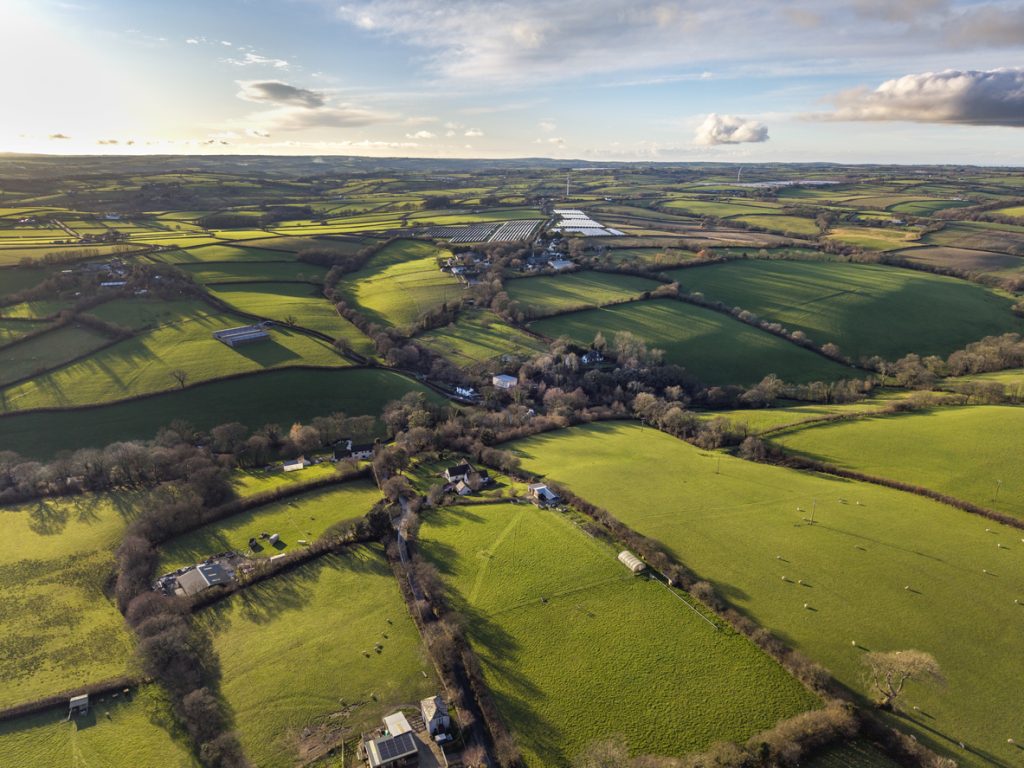
Five things worth knowing
- Whether your land sits inside or outside a settlement now decides almost everything. Policy S5 sets out what is supported outside settlements, and says it should be approved unless the benefits would be substantially outweighed by any adverse effects. Anything not on that list, according to S5(4), should be approved only in exceptional circumstances.
- Farm modernisation now counts for more. Policy E2(1)(b) asks decision-makers to give substantial weight to the benefits for domestic food production, animal welfare and the environment that your modernisation proposals can demonstrate.
- Your projects are named in the policy. Improved accommodation for livestock, on-farm reservoirs, greenhouses, polytunnels, farm shops and temporary seasonal worker accommodation all appear in policy E4(1) as development that supports farm viability, diversification and food production.
- An old, restrictive Local Plan policy may no longer stand in your way. Annex A, paragraph 2 says that development plan policies materially inconsistent with the new national decision-making policies should be given very limited weight, unless they were examined and adopted against this Framework.
- Don’t worry, your permitted development rights are untouched by this Framework. Permitted development rights reside in the General Permitted Development Order, which this Framework does not amend.
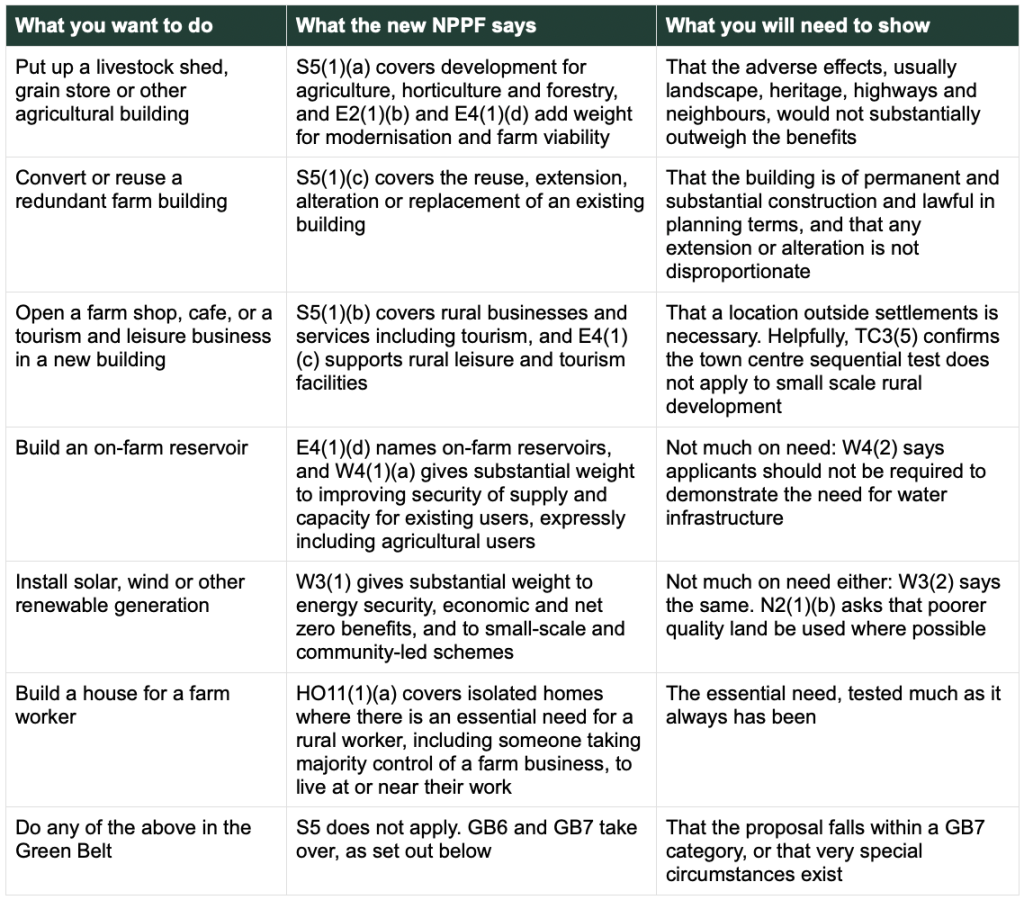
Inside or outside a settlement: the question everything now turns on
A word of context first. The Framework has been rewritten from the ground up. Landmark Chambers, whose barristers advised the Ministry of Housing, Communities and Local Government on the new NPPF, describes the August 2026 document as the first comprehensive rewrite of the NPPF since 2012. Interestingly, chapters and ascending paragraph numbers have gone, replaced by individually numbered policies, and paragraph 8 confirms that the plan-making policies are not to be used when deciding applications, constituting a general shift towards a more rules-based framework.
For landowners, one distinction now matters more than any other. Policy S3 sets the presumption in favour of sustainable development, and it is applied through policy S5 if your site lies outside of a settlement (cities, towns, villages and other predominantly built-up areas), which, in practice, relates to most farms and estates. Where a site is genuinely “on the urban fringe”, straddling a settlement boundary, S3(2) asks for policies S4 and S5 to be applied to the relevant parts.
So the useful question becomes: what does S5 conditionally say yes to? The table below covers the projects we are asked about most often.
The one test that catches new-build diversification
Six words in S5(1)(b) will decide a lot of schemes. If your tourism, retail or commercial venture involves a new building rather than the reuse of an existing one, you have to show that a location outside settlements is necessary.
Policy E4(2) is on your side here. It accepts that proposals meeting business needs in rural areas may need to sit outside settlements, and in places not well served by public transport, and asks in return that you take any opportunity to use previously developed land or a site physically well-related to existing development, with siting and design suited to the surroundings.
Our view is that this is a test to be evidenced rather than asserted, and the first appeal decisions will tell us how demanding it really is. It’s worth noting that a scheme reusing a building you already own avoids the test altogether, which remains a good reason to look hard at your existing buildings before designing something new.
Farm modernisation and diversification appear to carry more weight
Policy E2(1) asks for substantial weight to be given to the economic benefits of commercial development that lets a business invest, expand or adapt, and to the food production, animal welfare and environmental benefits demonstrated through farm and agricultural modernisation. The December 2024 Framework, at paragraph 88, asked policies and decisions to “enable” the sustainable growth of rural businesses. Naming farm modernisation and attaching substantial weight to it is new, and in our view it moves the planning balance.
Policy E4(1) then applies that to rural areas, supporting the conversion of existing buildings and well-designed new ones, the diversification of agricultural and other land-based businesses, facilities for rural leisure and tourism, measures to retain local shops and services, and the farm viability development listed earlier.
One practical point for retail and leisure. Policy TC3 keeps the sequential test for town centre uses, but TC3(5) says it does not apply to small scale rural offices or other small scale rural development. Commenting on the draft of that policy in Farmers Weekly earlier this year, rural planning advisers suggested it could open up opportunities that councils had previously resisted on sequential grounds. “Small scale” is not defined, so it pays to think about scale and format early on a larger farm shop or leisure scheme.
Energy and water
On energy and water, the Framework is warmer than it has been. Policy W3(1) gives substantial weight to renewable and low carbon energy and electricity network infrastructure for energy security, economic development and net zero, and to small-scale and community-led schemes. Policy W4(1) does the same for water supply, drainage and wastewater development, including security of supply and capacity for existing users, which it says expressly includes agricultural users. Neither policy requires you to demonstrate the need for the development itself. Read alongside E4(1)(d) and its reference to on-farm reservoirs, that is the clearest national support on-farm water storage has had.
Land quality is still a material consideration however. Policy N2(1)(b) asks proposals to take into account the quality of agricultural land, including best and most versatile land and its grade, and to use poorer quality land where possible if significant development of agricultural land is necessary.
If your land is in the Green Belt
Green Belt plays by its own rules. S5(5) says so plainly: neither policy S5 nor the list above applies there, or on Local Green Space. Instead policy GB6 starts from the position that development is inappropriate, and inappropriate development should not be approved unless there are very special circumstances.
The better news is that policy GB7 sets out what is not inappropriate, and a good deal of ordinary rural activity is on that list:
- Farming, horticulture and forestry, and work solely for nature conservation or habitat restoration (GB7(1)(a)).
- Reusing, extending, altering or replacing a building you already have (GB7(1)(b), subject to the size test below).
- Limited infilling in a village, and limited affordable housing for local needs such as a rural exception site (GB7(1)(c) and (d)).
- Redeveloping previously developed land, provided openness would not be substantially harmed (GB7(1)(e)).
- Outdoor sport and recreation and the facilities that go with them, along with water, electricity network and telecommunications infrastructure needed in a Green Belt location, all provided the impact on openness is minimised and there is no significant conflict with Green Belt purposes (GB7(1)(f)).
Grey belt has survived into the final version too. Under GB7(1)(g), development on grey belt land is not inappropriate provided four things stack up: it would not fundamentally undermine the purposes of the remaining Green Belt across the plan area; there is an evidenced unmet need for what you are proposing; the location is sustainable, judged with particular reference to policy TR3; and, for major housing, it meets the Golden Rules in policy GB8. Annex B now defines grey belt simply as Green Belt land, previously developed or otherwise, which does not strongly contribute to purposes (a), (b) or (d) in policy GB2.
If your land is in the Green Belt, the practical question is which GB7 box your project fits into. It is worth answering that before you spend money on design.
Three things that catch people out
- A redundant barn is not previously developed land. The Annex B definition excludes land last occupied by agricultural or forestry buildings, so the previously developed land route in S5(1)(d) is closed to you. Reuse runs through S5(1)(c) instead, or through Class Q or Class R.
- In the Green Belt, size is measured from a long way back. Outside the Green Belt, S5(1)(c) compares your proposal with the building as it stood when the Framework was published. Inside it, GB7(1)(b) compares against the original building, which footnote 40 pins to 1 July 1948, or to how it was first built if it went up later. A replacement also has to be not materially larger than the one it replaces.
- Your own new holiday let can become the neighbour that constrains your farm. Policy P4 protects existing businesses from unreasonable restrictions caused by development approved after they were established, and P4(2)(b) asks a new proposal to show that suitable mitigation can be in place before first occupation. P4(3) applies it to changes of use as well as new building, so a conversion beside a working farmyard is caught.
What should farmers and landowners do now?
If a project has been refused in the past on principle, rather than on a technical ground you cannot fix, it is worth another look against S5, E2 and E4. That is especially true where the refusal leaned on a countryside protection policy written under an earlier Framework, because Annex A, paragraph 2 now gives such policies very limited weight where they are materially inconsistent with national decision-making policy. It is fair to add that Annex A does not write off older plans wholesale: policies which are not inconsistent keep their weight, and should not be marked down simply for being old.
Two smaller points that are useful to have in your back pocket. DM3(1) expects councils to work with applicants positively and proactively, to take a proportionate approach, and not to refuse applications that should clearly be approved. DM4(2) limits refusing on grounds of prematurity to proposals so substantial that permission would predetermine decisions central to an emerging plan, and only where that plan is at an advanced stage.
Guidance and the first appeal decisions will settle how words like “necessary”, “small scale” and “disproportionate” are applied in practice.
We work with farms and estates across England on rural projects and diversification, from first idea conception through to completion, pulling together the planning, design, funding and delivery specialists a scheme needs so that you have one, specialist point of contact rather than five. If you would like to talk through what the new Framework means for your land, book a free consultation.
Frequently asked questions we’ve had about the new NPPF since its publication
When does the new NPPF take effect?
According to Annex A, paragraph 1, the policies in the Framework are material considerations in decision-making from the day of publication, which was 17 August 2026. Annex A, paragraph 6 provides that neighbourhood plans submitted to the local planning authority on or before that date are prepared against the December 2024 Framework.
Does the new NPPF change Class Q or Class R permitted development rights?
No. Permitted development rights sit in the General Permitted Development Order, which the NPPF does not amend. The Framework governs how planning applications and appeals are decided.
Does the new NPPF support farm diversification?
Yes. Policy E4(1) says the sustainable growth of businesses in rural areas should be supported, including through the conversion of existing buildings and well-designed new buildings, the development and diversification of agricultural and other land-based businesses, facilities for rural leisure and tourism, and development to maintain farm viability and support domestic food production, such as improved livestock accommodation, on-farm reservoirs, greenhouses, polytunnels, farm shops and ancillary seasonal worker accommodation. Policy E2 gives substantial weight to the food production, animal welfare and environmental benefits of farm modernisation.
Can I get planning permission for a farm shop, cafe or tourism business outside a village?
Policy S5(1)(b) supports development for rural businesses and services, including tourism, outside settlements where a location outside settlements is shown to be necessary. Reuse of an existing building falls under S5(1)(c). TC3(5) confirms that the town centre sequential test does not apply to small scale rural development.
Do redundant farm buildings count as previously developed land under the new NPPF?
No. The Annex B definition of previously developed land excludes land that is or was last occupied by agricultural or forestry buildings. Reuse of such buildings is supported under S5(1)(c), or GB7(1)(b) in the Green Belt, or through permitted development where Class Q or Class R applies.
Does policy S5 apply in the Green Belt?
No. S5(5) confirms that proposals in the Green Belt, and on land designated as Local Green Space, are determined under policies GB6, GB7, GB8 and HC8. Where development would not be inappropriate under GB7, it should be approved unless the benefits would be substantially outweighed by any adverse effects.