

Padel is the diversification enquiry of the moment. Barely a week passes without a farm or estate asking whether a redundant grain store could become a padel club. The demand is real, the planning routes are better than most landowners expect, and the capital requirement is modest next to almost anything else you could build on a farmyard.
It is also the quickest way to lose money in rural leisure since the last big idea.
Both statements are true at once and holding them together is the whole job. Here is where the UK market stands, what is happening on farms now, what Sweden should tell anyone about to commit capital, and what separates a good padel offering from a great one.
The UK numbers are exceptional, which is not the same as safe
According to the LTA, one million adults and juniors were playing padel in Britain by May 2026, across 1,825 courts at 551 venues. That follows 860,000 players at the end of 2025, 400,000 at the end of 2024, 129,000 in 2023 and just 15,000 in 2019. Court numbers have moved in step, from 870 at the end of 2024 to 1,553 a year later.
Two figures matter more than the headline. First, according to the LTA more than ten million adults have expressed an interest in trying the sport against one million actually playing. That gap is the investment case. Second, according to the LTA an off-peak booking averages around £7 per person per hour, or roughly £27 an hour for a doubles court. This is a volume business at a modest unit price.
Supply is arriving fast to close the gap. According to Savills, operator competition is intensifying, with Slazenger Padel backed by Frasers Group planning eleven venues in 2026, Powerleague converting five-a-side sites, and The Padel Club, Game4Padel and Rocket Padel expanding regionally. Institutional capital is now in the sector at scale.
For a farm, the reading is straightforward. Demand is real and under-served. Supply is arriving faster than many local catchments can absorb. The window in which scarcity alone carries a scheme is closing, and in some places it is closing quickly.
Why farms are unusually well placed
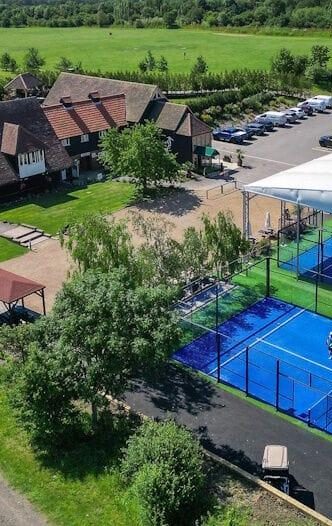
The physical fit is good. According to Farmers Weekly, a padel court needs roughly seven metres of height to the apex, which redundant grain stores routinely have and few other commercial buildings do. Farmyards also arrive with hardstanding, an access, parking and a power supply. The cost of entry is comparatively low: according to Farmers Weekly, two courts cost in the region of £75,000 to install, with covering them capable of doubling the bill. Against a barn conversion or a wedding venue, that is a small ticket.
The cost base is different, too. According to Farmers Weekly, some London courts charge around £100 an hour while a rural operator running at roughly £30 an hour can still be busy, because the farm is not paying industrial estate rent. That is a durable advantage, and the one farm schemes most often fail to price properly. Rural catchments are also genuinely under-served: in the Northumberland scheme below, the nearest courts are 23 miles away.
What is actually happening on UK farms
Activity has moved well past enquiry stage.
According to Farmers Weekly, the consultancy PadelMagic UK installed around 30 courts on farms and rural estates in a single year and expected to roughly double that the following year, alongside running its own clubs on leased sites including Todenham Barn in the Cotswolds and a new club at the Royal Agricultural University.
Also according to Farmers Weekly, two courts opened in a former grain store on the 800-hectare Bromborough Estate at Podington in north Bedfordshire, financed in-house after a change of cropping reduced the need for grain storage. The estate reports being booked out every evening, provides free rackets and balls, and gives local residents a discount. According to Bedford Today, however, the scheme is now the subject of a part-retrospective change of use application, an earlier request having been refused because officers considered it a more intensive sport and recreation use rather than small-scale development. It has drawn more than 130 letters of local support and been called in by a ward councillor.
Elsewhere, according to Farmers Weekly a fifth-generation arable farmer near Sunderland has applied for six indoor courts and a café at Offerton, citing declining contracting work. According to the Northumberland Gazette, an application at Lowick Hall Farm proposes two courts alongside gym rooms, changing facilities and seating, replacing an asbestos-clad building whose roof height was too low to convert. According to the Yorkshire Post, a farming group in the East Riding is seeking consent for two outdoor courts on previously surfaced ground, presented explicitly as farm diversification.
The pattern is consistent. Working farms, redundant fabric, and most of them pairing padel with something else.
The Swedish warning
Sweden is the case study to read before signing anything.
According to Padel Fast, padel in Sweden went from niche to national obsession in under a decade, with thousands of courts built between 2018 and 2021 on the expectation of continued exponential growth, including in towns where demand was overestimated. By 2022 occupancy was falling and operators were struggling with rent and running costs.
The correction was severe. According to European Business Magazine, Sweden went from a few hundred courts to more than 4,200 in 36 months, with Uppsala alone rising from 14 courts to nearly 100 in one year. By the end of 2024 more than 100 facilities had closed and around 90 padel companies had filed for bankruptcy. Triton-backed We Are Padel closed 50 of its 63 Swedish clubs, and industry estimates put the capital destroyed at close to €500 million. Some halls became discount supermarkets; others now store solar panels and tyres.
The critical point is what did not happen. According to European Business Magazine, citing International Padel Federation data, more than 600,000 Swedes were still playing in early 2024, a participation rate per head higher than anywhere in Europe except Spain. This was not a demand collapse. It was a supply collapse, caused by a financing model that mistook a participation boom for an infrastructure thesis.
The trigger was energy: according to the same source, electricity prices in southern Sweden ran at roughly five times pre-2020 levels by winter 2022, making it uneconomic to heat and light large indoor halls through a Nordic winter. The underlying weakness was that the facilities had no defensible position. In the magazine’s phrase, they were warehouses with nets in them, sitting beside identical competitors chasing the same off-peak booking.
Nor is this only Swedish. According to reporting on the Global Padel Report 2026 by Playtomic and Strategy& by PwC, the global challenge is no longer building courts but filling them, with Chile swinging from shortage to surplus and recording a sharp fall in monthly bookings alongside more than 80 club closures. According to Padel Magazine, even in Spain a 35-court club at Alcobendas went bankrupt repeatedly before its owner stopped.
What the survivors did differently
The clubs that came through did not survive on price or scale.
According to European Business Magazine, three things separated them: location, with urban operators holding utilisation above 70% through the worst of the energy crisis while suburban sites did not; programming, with coaching academies, structured leagues and corporate nights turning a booking into a recurring social commitment; and hospitality, with café, bar and event space holding footfall when bare-court operators lost theirs. According to Padel Tonic, We Are Padel retained 13 sites and shifted them from selling bookings to building communities through coaching, junior sessions, leagues and socials. According to Padel Fast, the lessons are that growth must be demand-driven rather than speculation-driven, that quality outperforms quantity, and that community engagement is critical.
Reduced to a sentence: the asset is a membership and community business with courts attached, not a property investment with bookings attached.
The planning position in England
The routes are better than most landowners assume. The traps are more expensive than most realise.
Use classes.
According to Freeths, indoor padel falls within Use Class E(d), covering indoor sport, recreation or fitness. Outdoor padel generally falls within Class F2(c). Where a building already holds a use in the same class, the change of use is not development, though existing conditions and section 106 obligations should be checked first.
Class R.
Class R of Part 3, Schedule 2 of the GPDO 2015 permits the change of use of an agricultural building, and land within its curtilage, to a flexible commercial use including Class E and, since 21 May 2024, Class F2(c). The cumulative floorspace cap across the agricultural unit doubled to 1,000 sq m on the same date. The building must have been solely in agricultural use as part of an established agricultural unit on or before 3 July 2012, or for ten years if built later. Below 150 sq m only notification is required; above that, prior approval applies.
The trap.
Class R permits the change of use only. The frame, glazed panels, playing surface, lighting and any alteration to the building envelope are operational development and need separate planning permission. Class R gets you the use, not the works. Schemes that treat prior approval as the finish line rather than the starting gun are the ones that end up applying retrospectively.
A misconception worth correcting.
Class Q is the permitted development right for converting agricultural buildings to dwellings. It has no application to a padel court. Advice suggesting Class Q covers sporting uses should be treated with caution.
The sequential test.
This is the issue most likely to catch a farm scheme, and it explains the Podington refusal. According to Freeths, because indoor padel sits in Class E(d) a local planning authority may treat it as a main town centre use under the NPPF, requiring a sequential test to show no suitable town centre or edge-of-centre site is available. Using a building that already has a Class E use avoids the requirement. On an out-of-centre farm relying on a change of use from agriculture, expect to argue it.
Noise and hours.
According to Freeths, LTA guidance indicates that residential property within 50 metres of proposed courts will usually trigger noise and lighting surveys by specialist consultants. Padel is a percussive sport played late. According to the Rotherham Advertiser, an environmental health officer who visited courts in Wakefield compared the noise to gunfire, and the scheme was approved against officer recommendation only with an unusual condition requiring opening hours to be separately agreed. Hours conditions are not a planning detail. They are the revenue model.
Everything else.
Lighting design, landscape impact, Green Belt and designated landscapes, biodiversity net gain, highways capacity, parking and drainage all apply. According to Freeths, further BNG exemptions were expected from the end of July 2026 for sites under 0.2 hectares and certain temporary permissions, which is worth checking against your red line.
Policy support.
Paragraphs 88 and 89 of the NPPF (December 2024, as amended February 2025) require decisions to support a prosperous rural economy and specifically recognise agricultural diversification. That is a material consideration in your favour, particularly where the enterprise is genuinely connected to the farm business. A revised NPPF has been expected since the consultation closed in March 2026, and the direction of travel is more supportive of rural enterprise, not less.
Structure, ownership and tax
There are three broad routes, carrying different risk and different tax outcomes. Run it yourself and you keep the margin, carry the operating risk, and hold a trading business. Lease to an operator and you take a rent, shed the risk, and hold something that looks a good deal more like an investment. According to Farmers Weekly, a third route is increasingly common, in which the installer funds the courts and booking system in return for a percentage of court fees.
The tax consequence deserves early attention. Business property relief applies to trading businesses, not investment businesses, and since 6 April 2026 the 100% rate of agricultural and business property relief has been capped at £2.5 million of combined qualifying value per person, with 50% relief above that. A passively let padel facility and an operated padel club are not the same asset for these purposes. This is not tax advice and the position turns on the facts, but the structuring decision belongs with your tax adviser at feasibility stage, not after the courts are in.
Good versus great
A good padel offering is two courts in a barn, an app, a card reader and a car park. In an under-served rural catchment it will fill for eighteen months on novelty and scarcity. It will then meet its second and third competitor, and the question becomes whether anyone has a reason to keep coming.
A great one is designed so that the court is the reason people come the first time, and not the reason they stay.
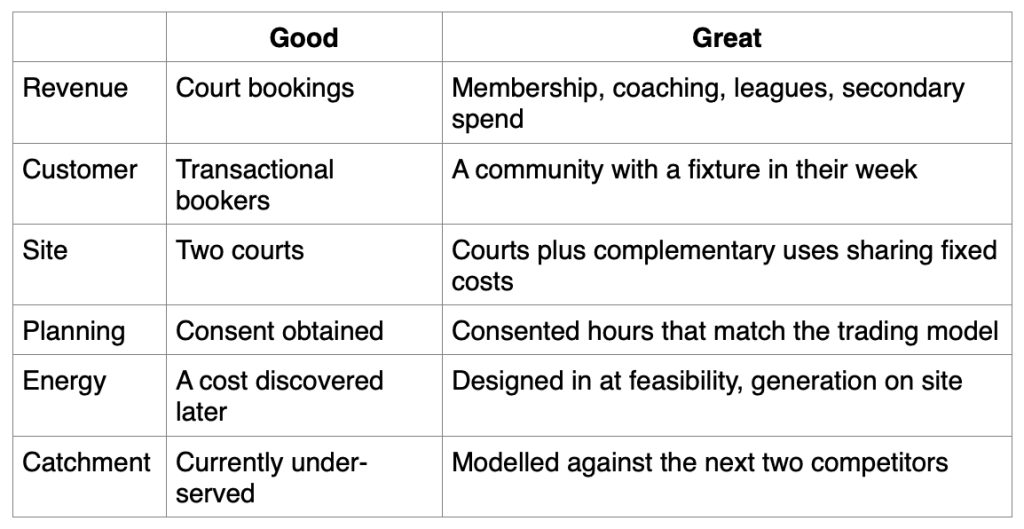
Programming, not bookings. Coaching, ladders, leagues, junior and women’s sessions and corporate nights convert discretionary spend into a recurring commitment. This was the strongest predictor of survival in Sweden, and it costs far less to build than a third court.
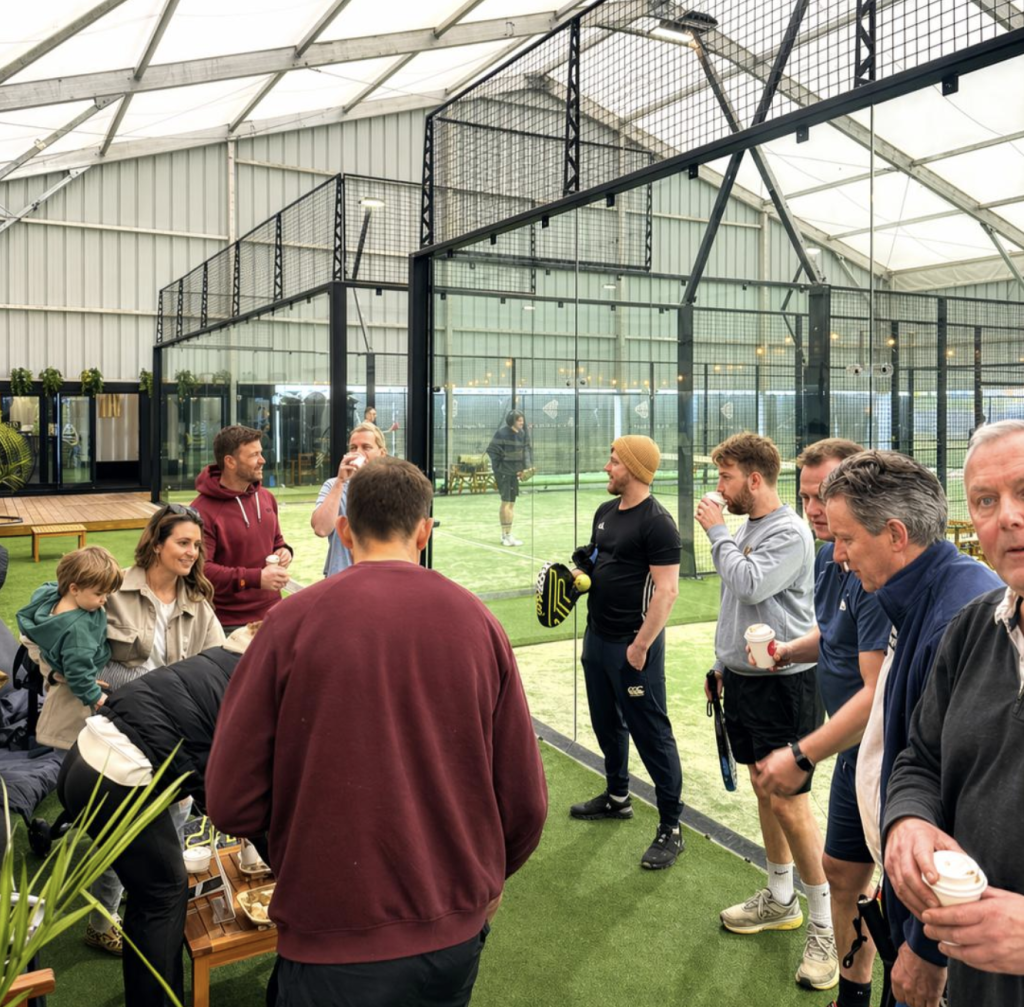
Hospitality and dwell time. Somewhere to eat, drink, watch and hold an event lengthens the visit, lifts secondary spend, and is the part an industrial estate operator cannot easily copy. A farm arrives with a setting, a story and often the produce already.
Stacked uses on one site. Padel alongside a gym, wellness space, food and drink, a farm shop, workspace, events or accommodation spreads fixed costs across more revenue lines and softens the consequence of anyone underperforming. Note how many live applications already do this: gym rooms at Lowick, a café at Offerton. Shared parking, drainage, utilities, staff and marketing are where returns actually improve.
Catchment discipline. Sweden’s casualties were sites with no defensible position. Ask how many people live within a twenty-minute drive, how many courts are open or consented in that radius, and what happens when the next two schemes land. Rural scarcity is a real advantage, but it is temporary, and it is not a strategy.
Operating cost designed in. Lit and heated indoor space is the line that broke the Swedish market. Roof-mounted generation, lighting specification, heating strategy and fabric performance belong in the feasibility model, not in a panicked review in year three.
Sequencing. Feasibility before planning, planning before procurement, procurement before commitment. According to Farmers Weekly, one specialist observes that many prospective operators have heard about padel socially and are hugely naive about cost and process. Retrospective applications, refusals and stranded capital are usually sequencing failures rather than bad ideas.
Where Dudley Peverill comes in
Padel is a good idea attached to a hard project. The sport is not the difficult part. The difficult part is a catchment appraisal that survives contact with the next competitor, a planning strategy that anticipates the sequential test and the hours condition, a building that works structurally and thermally, and a structure that does not quietly damage your tax position.
We work with farms and estates from concept to completion across RIBA Stages 0 to 6, starting with an Estate Masterplan that tests whether padel is the right use for the site at all, and how it sits alongside everything else the holding could do.
The most valuable thing you can do is spend a small amount working out whether the scheme stands up, before you spend a large amount finding out.
Questions to answer before you commit
- How many people live within twenty minutes, and how many courts already serve them?
- What is open, consented and in the pipeline within that catchment?
- Indoor or outdoor, and does the building have the height and span?
- Which planning route applies, and does a sequential test bite?
- How close is the nearest dwelling, and what hours will you realistically be consented for?
- Does the model still work at consented hours rather than ideal hours?
- Will you operate, lease or revenue-share, and what does that do to your tax position?
- What else goes on the site, and does the scheme stand up if padel underperforms?
Frequently asked questions
Do I need planning permission for a padel court on my farm? Almost always something is required. An indoor court in a qualifying agricultural building may achieve the change of use under Class R prior approval, but the physical works need separate permission. An outdoor court on open agricultural land requires full planning permission for both the use and the structure.
Can I use Class Q for a padel court? No. Class Q relates to converting agricultural buildings to dwellings. Class R is the relevant permitted development right for commercial and sporting uses.
How much does a padel court cost to install? According to Farmers Weekly, around £75,000 for two courts, with covering capable of doubling that. Fit-out, lighting, changing facilities, parking, drainage and professional fees sit on top.
Is the UK padel market about to crash? The UK is not Sweden and participation is still rising sharply. But according to European Business Magazine the UK pipeline shares structural features with the Swedish market of early 2022, and according to the Global Padel Report 2026 overcapacity is now the sector’s central challenge globally. Well-located, well-programmed clubs will be fine. Undifferentiated ones will not.
Is a padel court useful for inheritance tax planning? It depends on whether you are trading or letting, and on the value of your other qualifying assets against the £2.5 million allowance in force since 6 April 2026. Take specialist tax advice before you fix the structure.